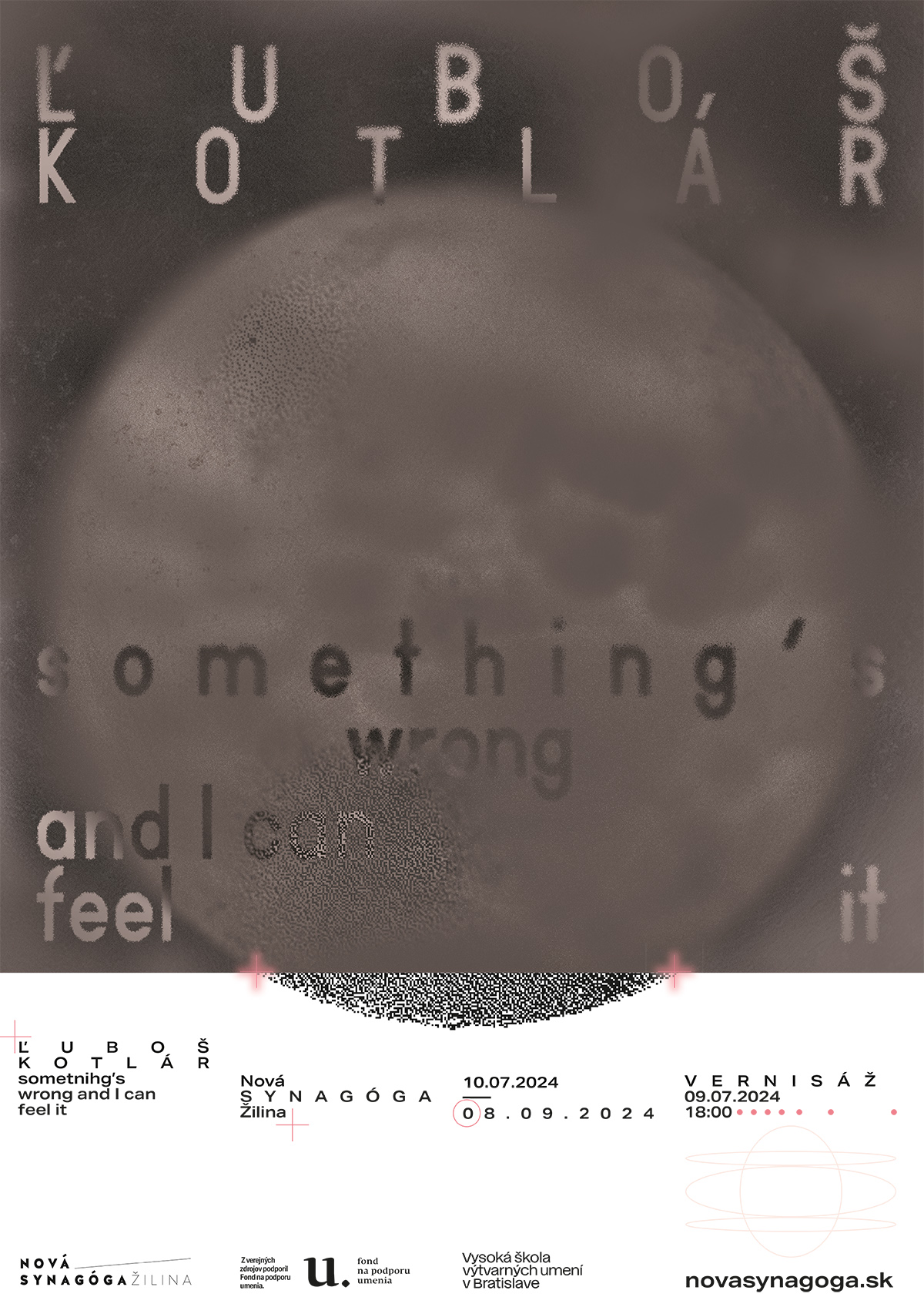
something's wrong
and i can feel it
site-specific installation
9 July – 8 September 2024
Nová synagóga
Žilina, Slovakia
exhibition design: Gabriela Smetanová
sound: NaiKavols
texts: Erik Vilím, Ľuboš Kotlár
graphic design: Dávid Koronczi
photo documentation: Richard Köhler, Ľuboš Kotlár
*project was financially supported by Slovak Arts Council and Academy of Fine Arts and Design in Bratislava
9 July – 8 September 2024
Nová synagóga
Žilina, Slovakia
exhibition design: Gabriela Smetanová
sound: NaiKavols
texts: Erik Vilím, Ľuboš Kotlár
graphic design: Dávid Koronczi
photo documentation: Richard Köhler, Ľuboš Kotlár
*project was financially supported by Slovak Arts Council and Academy of Fine Arts and Design in Bratislava
Over the past several years, my writing and artistic practice have repeatedly returned to the notion of a multiplicity of crises as a defining condition of the present. Rather than a single rupture, contemporary life appears structured by overlapping states of instability - ecological, political, technological, and affective. Uncertainty emerges as the dominant experiential mode, operating simultaneously on individual and collective scales, producing a pervasive atmosphere of anticipatory anxiety. Within this context, my work has increasingly engaged with questions of temporality: how, in the absence of a legible or reliable future, attention collapses into the immediacy of the present moment, displacing long-term projection and planning in favor of heightened perception of what is unfolding now.
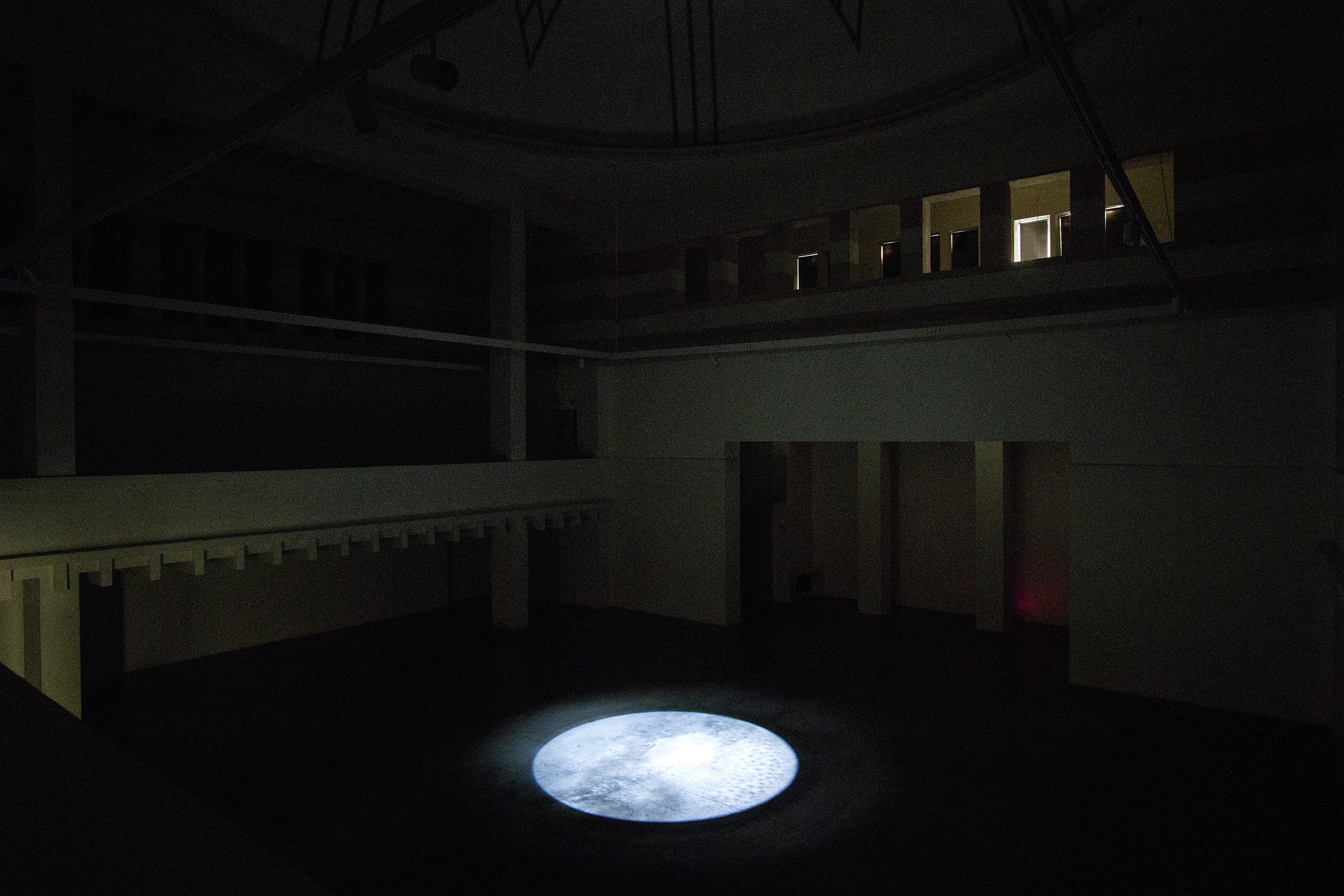
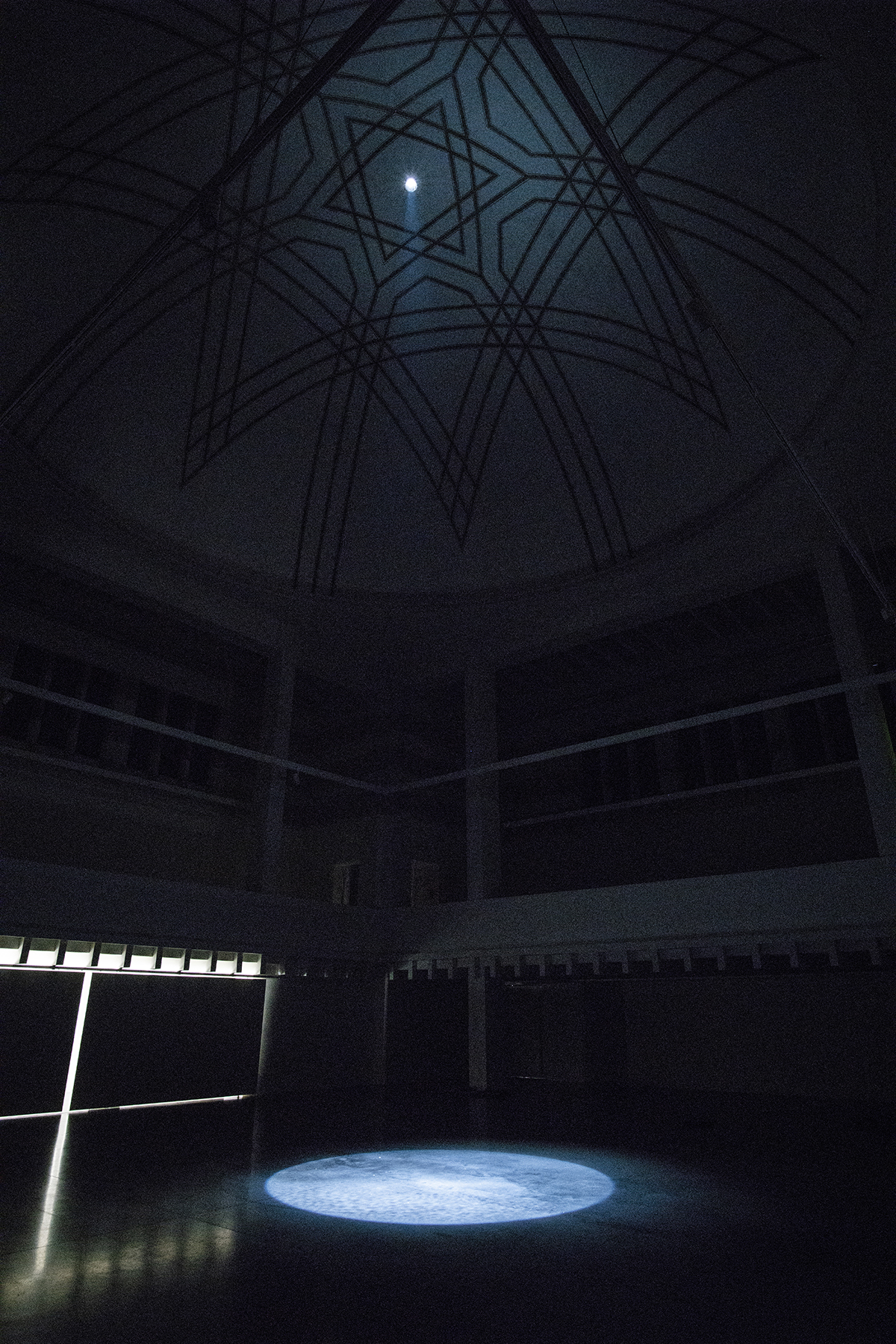
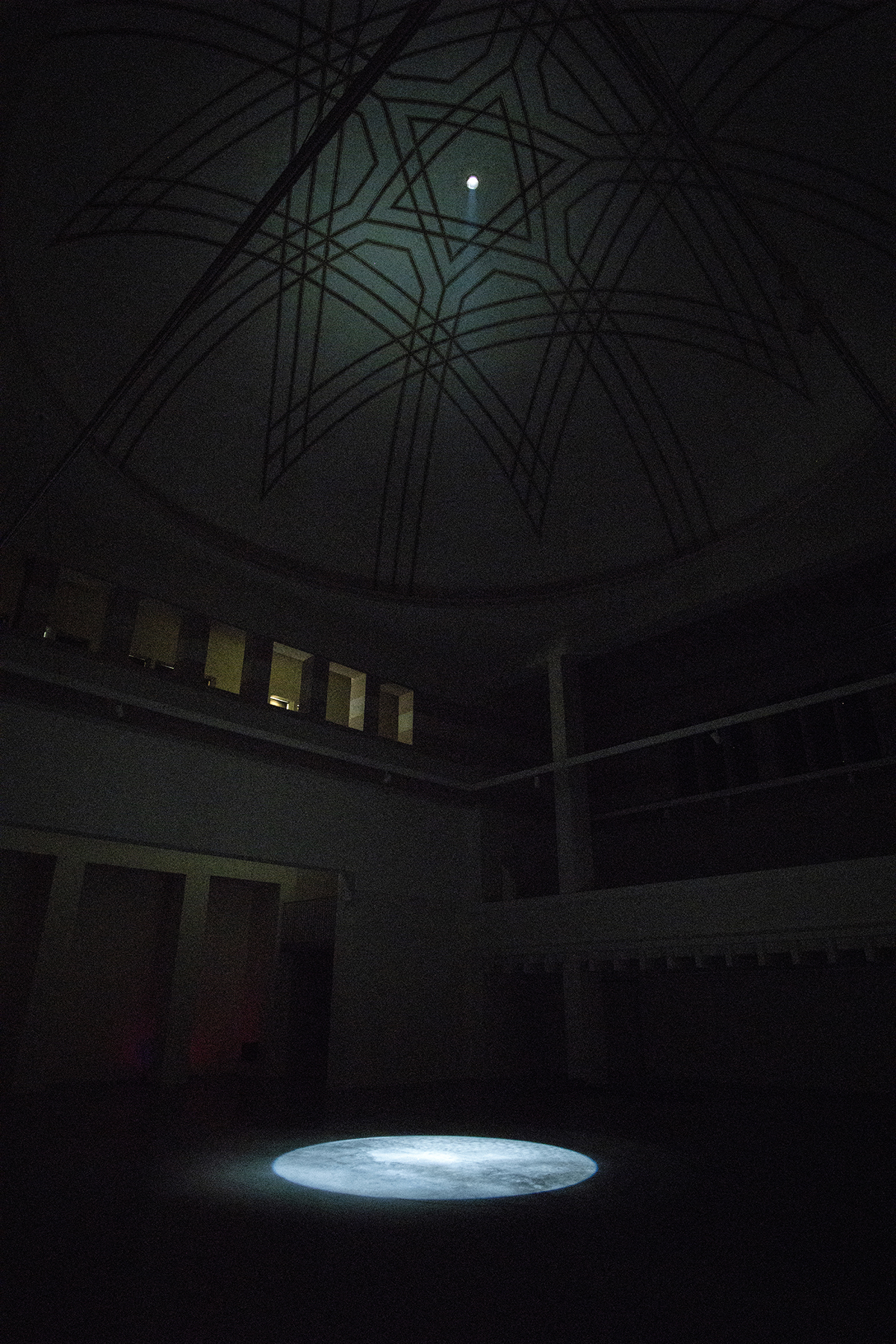
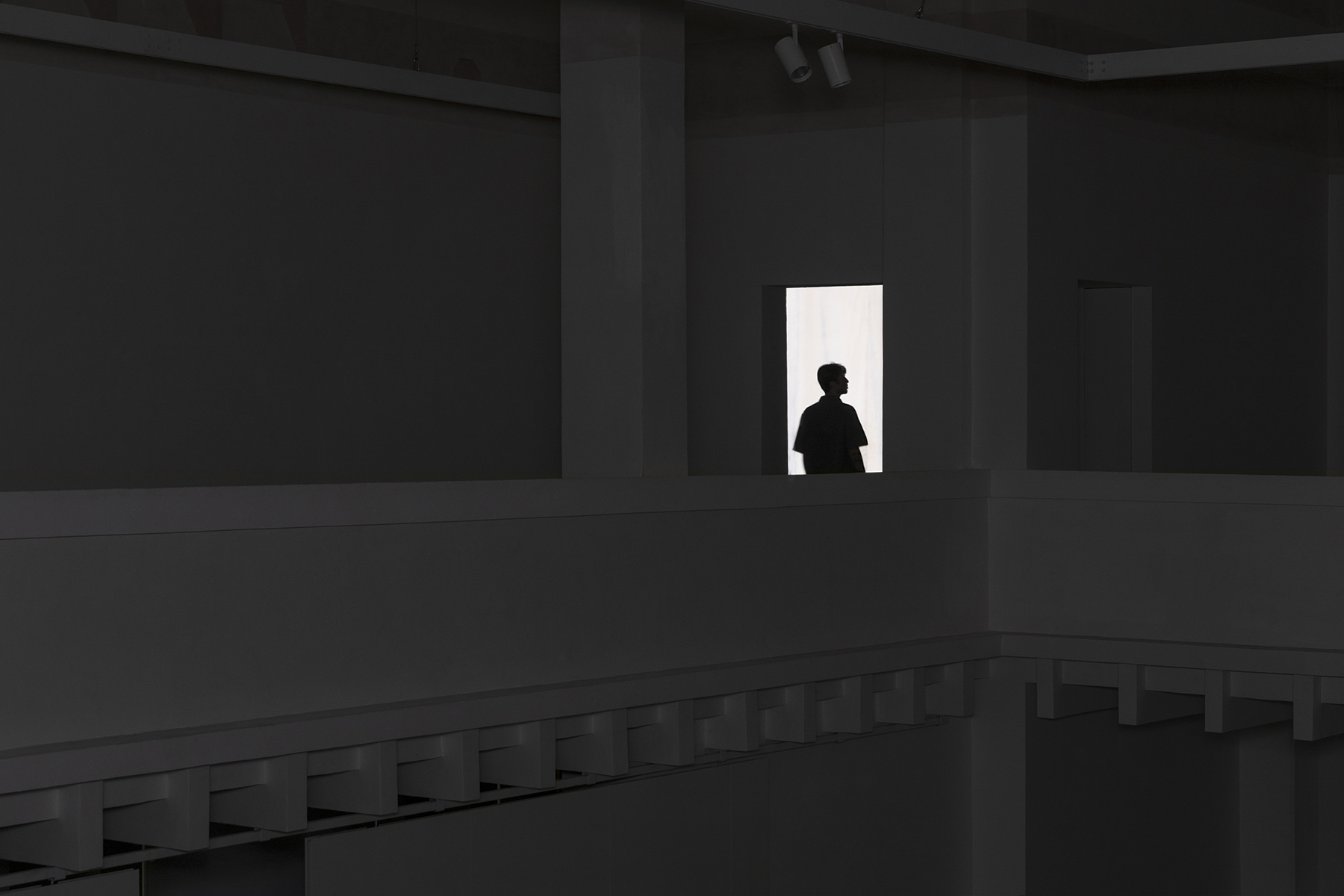
The exhibition 'something’s wrong and i can feel it' is conceived in direct dialogue with the architectural and symbolic specificity of the New Synagogue. By uncovering an existing aperture in the dome, the building is reconfigured as a camera obscura, a primordial optical apparatus that predates photography and situates vision within a pre-industrial epistemology of light and observation. When the interior is sufficiently darkened, the sky above the synagogue is projected onto the floor beneath the dome, transforming the sacred interior into a site of inversion and transference. The image (composed of shifting atmospheric conditions) is unstable, contingent, and beyond the artist’s control. Its apprehension demands time, attentiveness, and a gradual physiological adjustment to altered visual conditions, foregrounding perception as a durational and embodied process.
The observation of the sky is echoed in the fountain installed in one of the synagogue’s towers. Made from industrial materials, the fountain holds a bucket and a moon, referencing a Romani custom of bowing to the new moon. In this tradition, men carried a bucket filled with water and small coins, believing that as the moon grew, so would their wealth (Lacková, Elena. I Was Born Under a Lucky Star. 2023).The choice of industrial materials reflects contemporary Romani realities in Central Europe, where many men today work in construction. By translating a ritual gesture into the material language of labor and infrastructure, the fountain connects ancestral belief systems with present-day economic conditions.
The exhibition 'something’s wrong and i can feel it' is conceived in direct dialogue with the architectural and symbolic specificity of the New Synagogue. By uncovering an existing aperture in the dome, the building is reconfigured as a camera obscura, a primordial optical apparatus that predates photography and situates vision within a pre-industrial epistemology of light and observation. When the interior is sufficiently darkened, the sky above the synagogue is projected onto the floor beneath the dome, transforming the sacred interior into a site of inversion and transference. The image (composed of shifting atmospheric conditions) is unstable, contingent, and beyond the artist’s control. Its apprehension demands time, attentiveness, and a gradual physiological adjustment to altered visual conditions, foregrounding perception as a durational and embodied process.
The observation of the sky is echoed in the fountain installed in one of the synagogue’s towers. Made from industrial materials, the fountain holds a bucket and a moon, referencing a Romani custom of bowing to the new moon. In this tradition, men carried a bucket filled with water and small coins, believing that as the moon grew, so would their wealth (Lacková, Elena. I Was Born Under a Lucky Star. 2023).The choice of industrial materials reflects contemporary Romani realities in Central Europe, where many men today work in construction. By translating a ritual gesture into the material language of labor and infrastructure, the fountain connects ancestral belief systems with present-day economic conditions.
This simple act recalls a gesture of collective memory and belief, while offering a moment of pause - an acknowledgment of impermanence, repetition, and the quiet persistence of ritual in everyday life.
The marble panels installed in the second tower are engraved with daily inscriptions generated by Co–Star, an astrology application that translates my natal chart into a continuous stream of textual prompts - part mantra, part directive. These utterances are produced through a hybrid apparatus that fuses astrological symbolism with artificial intelligence and large-scale data processing, recoding ancient cosmological systems through contemporary computational logics.The work draws attention to the persistence and mutation of superstition across historical epochs: from celestial divination and mythic cosmologies to algorithmically mediated forms of belief. It examines how meaning continues to be ascribed to cosmic objects through interfaces that obscure their technological infrastructure behind the rhetoric of intuition, personalization, and fate. In this sense, the application operates as a secular oracle, an AI-driven proxy for mysticism, whose authority occupies an ambiguous position between irrational belief and data-driven rationality.By inscribing these machine-generated utterances into marble, a material historically associated with monumentality, permanence, and institutionalized knowledge, the installation stages a temporal collision between the deep time of ancient belief systems and the accelerated, disposable rhythms of digital culture. The work reflects on how such structures of belief not only persist but proliferate within late-capitalist, technologically saturated societies, where algorithmic systems increasingly mediate intimacy, subjectivity, and the production of meaning itself.
'something’s wrong and i can feel it' ultimately proposes the exhibition space as a site of deceleration and introspection. It invites the audience into a provisional refuge for embodied awareness - attentive to perception, impermanence, and ephemerality. Visitors are welcome to throw a few pennies into the fountain and read the motivational inscriptions, engaging in gestures that oscillate between irony and sincerity, skepticism and faith. Everything will be all right.
The marble panels installed in the second tower are engraved with daily inscriptions generated by Co–Star, an astrology application that translates my natal chart into a continuous stream of textual prompts - part mantra, part directive. These utterances are produced through a hybrid apparatus that fuses astrological symbolism with artificial intelligence and large-scale data processing, recoding ancient cosmological systems through contemporary computational logics.The work draws attention to the persistence and mutation of superstition across historical epochs: from celestial divination and mythic cosmologies to algorithmically mediated forms of belief. It examines how meaning continues to be ascribed to cosmic objects through interfaces that obscure their technological infrastructure behind the rhetoric of intuition, personalization, and fate. In this sense, the application operates as a secular oracle, an AI-driven proxy for mysticism, whose authority occupies an ambiguous position between irrational belief and data-driven rationality.By inscribing these machine-generated utterances into marble, a material historically associated with monumentality, permanence, and institutionalized knowledge, the installation stages a temporal collision between the deep time of ancient belief systems and the accelerated, disposable rhythms of digital culture. The work reflects on how such structures of belief not only persist but proliferate within late-capitalist, technologically saturated societies, where algorithmic systems increasingly mediate intimacy, subjectivity, and the production of meaning itself.
'something’s wrong and i can feel it' ultimately proposes the exhibition space as a site of deceleration and introspection. It invites the audience into a provisional refuge for embodied awareness - attentive to perception, impermanence, and ephemerality. Visitors are welcome to throw a few pennies into the fountain and read the motivational inscriptions, engaging in gestures that oscillate between irony and sincerity, skepticism and faith. Everything will be all right.
About words beggining with P
I have previously used the term perception many times within my research publications. I must admit that I have been trying to avoid it, perhaps precisely due to its academic tone. If we stopped or are about to stop by the solo exhibition of Ľuboš Kotlár placed in Žilina´s Nová synagóga, it is worth embracing this term again after a certain time.
The concept of perception is best understood if we evalue it with the help of another term - perspective. Perception is not more than receiving certain data through our sensory endings. There is something uncontrollable in this process of "absorption" of the surroundings, a kind of flow - pure seeing or hearing right here, right now and in this environment.
Even these words are slowly pouring into you. Your eyes register the contrast between the white paper and the black font called Lucida Grande. Based on this data, you can compose successive sentences. Perception is therefore "this" manifestation of the world - perception is a stream, by which the World flows into us.
I have previously used the term perception many times within my research publications. I must admit that I have been trying to avoid it, perhaps precisely due to its academic tone. If we stopped or are about to stop by the solo exhibition of Ľuboš Kotlár placed in Žilina´s Nová synagóga, it is worth embracing this term again after a certain time.
The concept of perception is best understood if we evalue it with the help of another term - perspective. Perception is not more than receiving certain data through our sensory endings. There is something uncontrollable in this process of "absorption" of the surroundings, a kind of flow - pure seeing or hearing right here, right now and in this environment.
Even these words are slowly pouring into you. Your eyes register the contrast between the white paper and the black font called Lucida Grande. Based on this data, you can compose successive sentences. Perception is therefore "this" manifestation of the world - perception is a stream, by which the World flows into us.
The perspective is radically different, it is aimed at something, it is a specific view. Perspective changes the framework of what we see. While the perception is only one, constantly passing, happening, we can take many perspectives on it. We can observe one thing from several angles and always see it in a different perspective. The camera is an example of this. You simply move it and it will stop this "flow" at your command. Astronomers recently took another photo of the black hole in the M87 galaxy, taking a new perspective, but despite this, the image is very similar to the previous one from 2019. However, there is definitely a small difference in it, which has its own scientific value. But let's leave that aside for now.
If we can comprehend this difference between the words perception and perspective clearly, we can now ask ourselves a simple question - where are we at in the work of Ľuboš Kotlár? Do we perceive, accept this flow, the flowing sky, or do we take perspective? Would our perspective be different if we arrived on a different day? And do we need a perfect image on the floor of Nová synagóga in Žilina, if our "smart" phones can master that?
If we can comprehend this difference between the words perception and perspective clearly, we can now ask ourselves a simple question - where are we at in the work of Ľuboš Kotlár? Do we perceive, accept this flow, the flowing sky, or do we take perspective? Would our perspective be different if we arrived on a different day? And do we need a perfect image on the floor of Nová synagóga in Žilina, if our "smart" phones can master that?
Erik Vilím
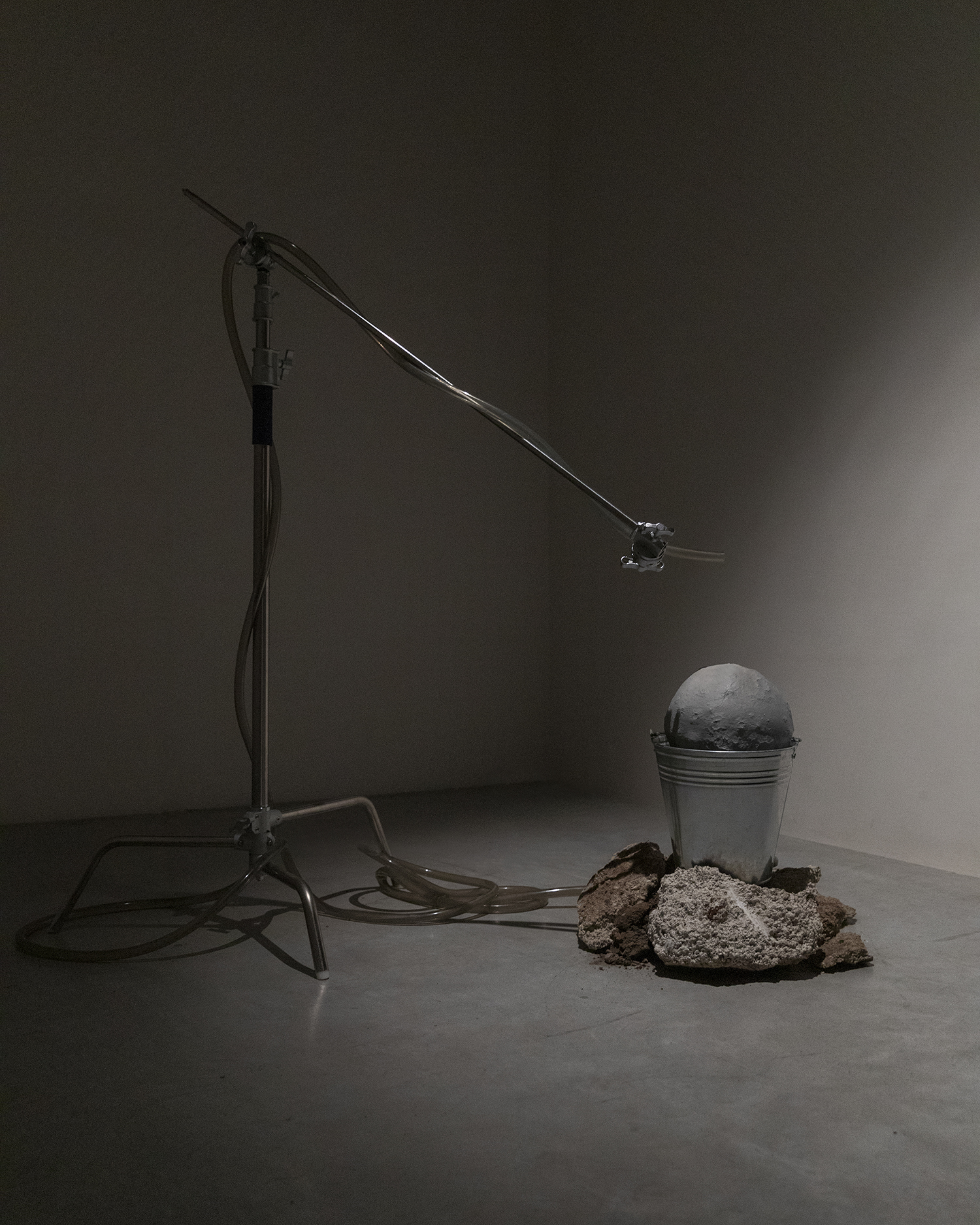
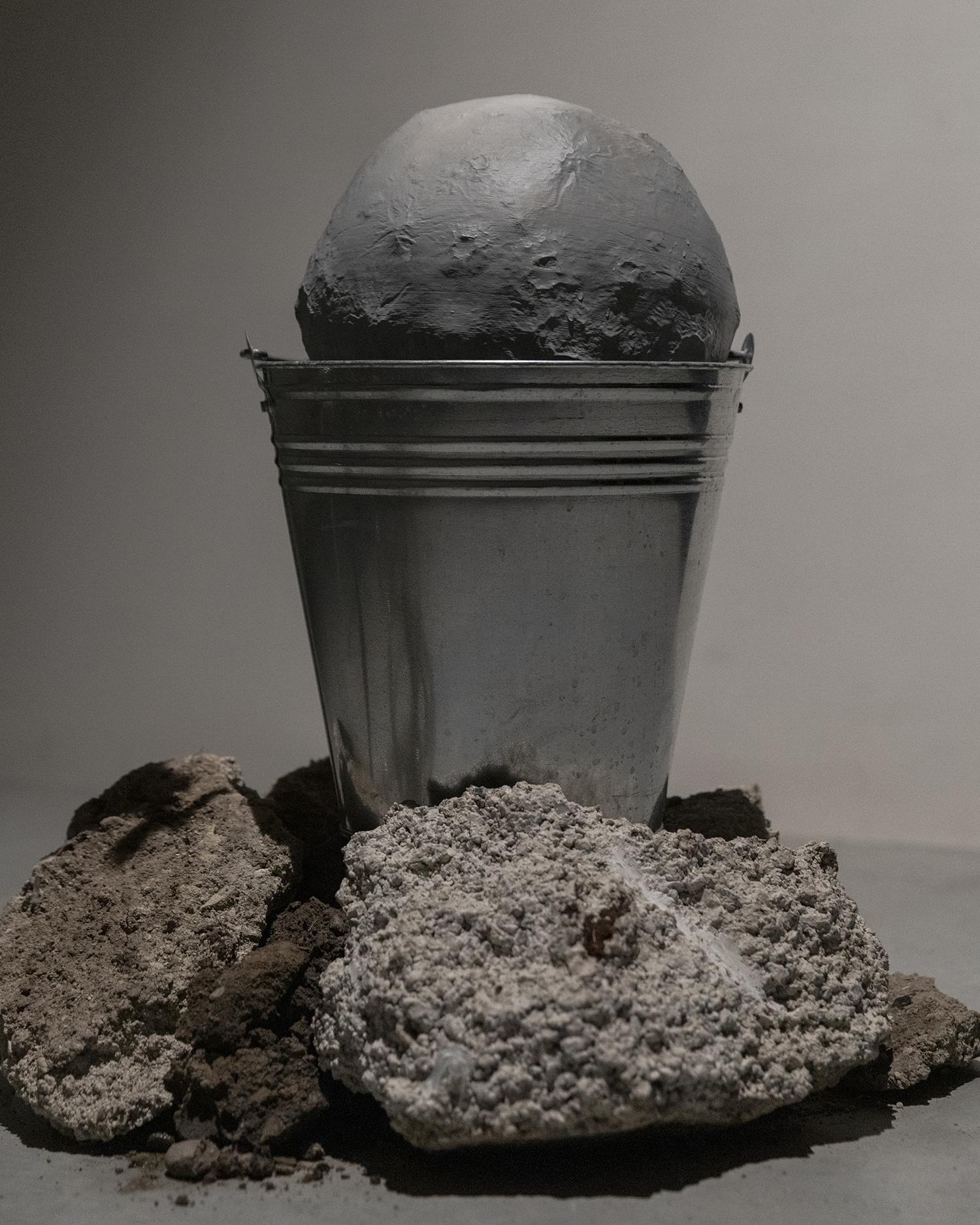
Untitled (Fountain)
various size
3D print, found metal bucket, found rubble, metal tripod, PVC hose, stepper motor, pump
2024
various size
3D print, found metal bucket, found rubble, metal tripod, PVC hose, stepper motor, pump
2024
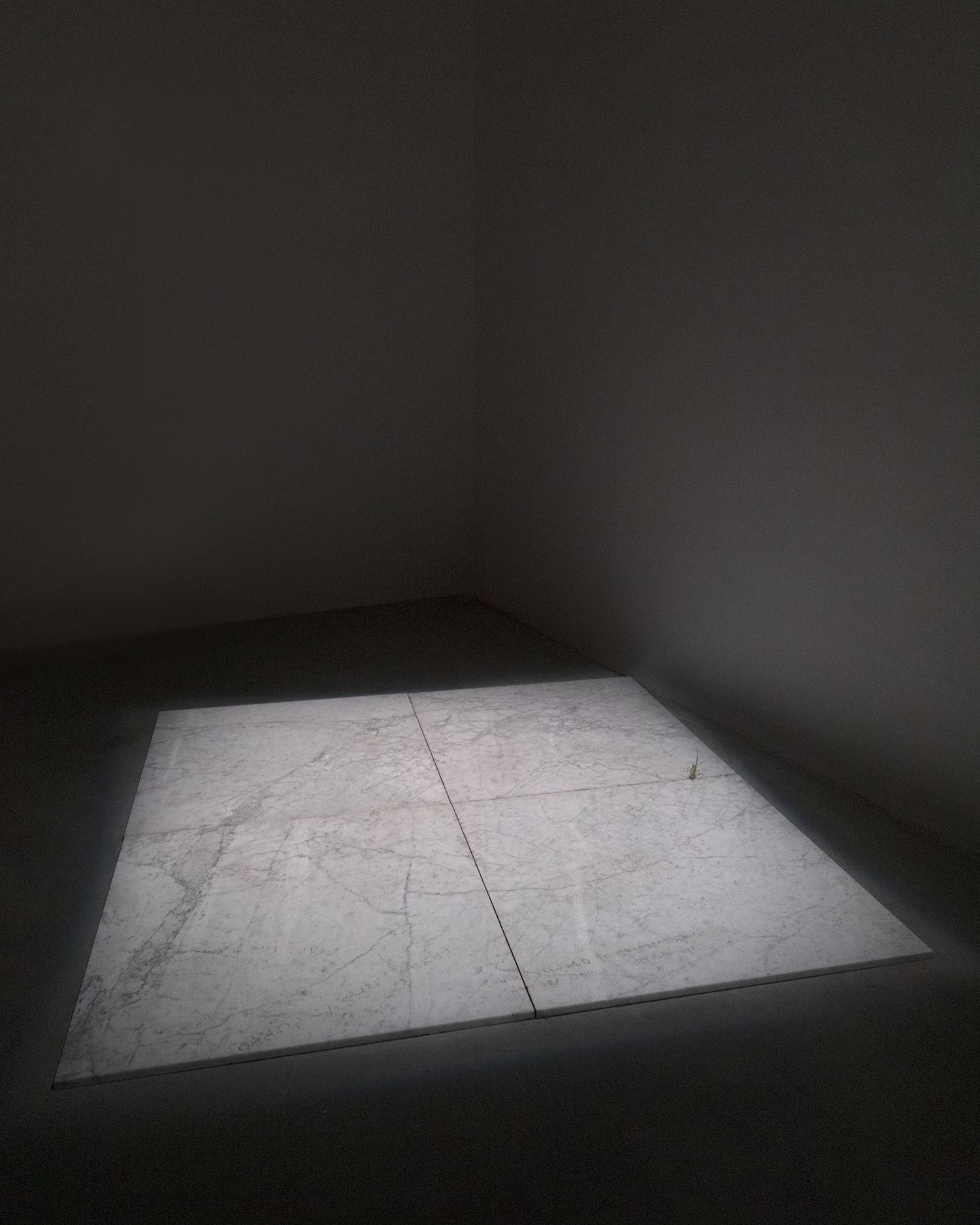
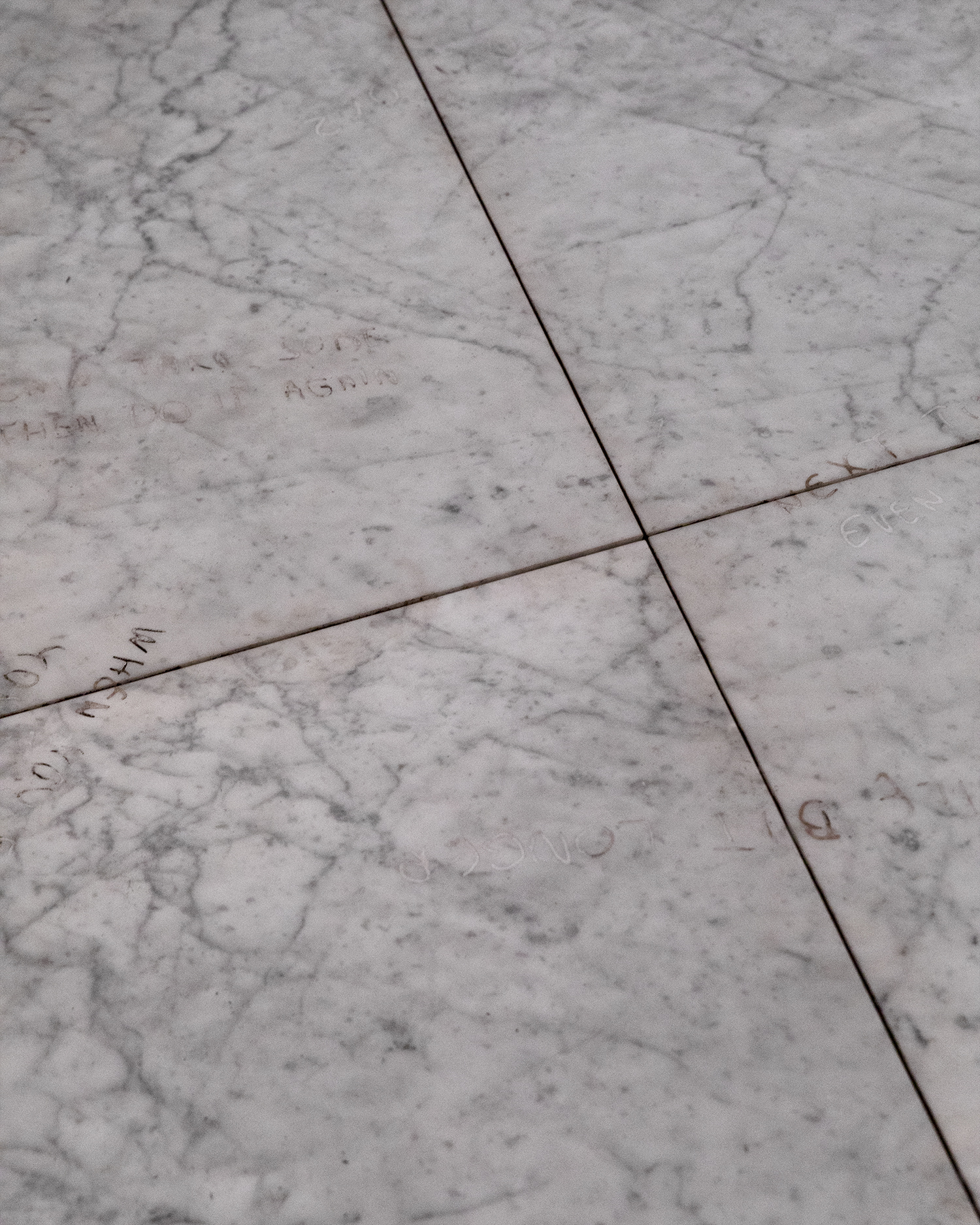
Untitled (Lapidarium)
200x200cm
engraved marble, dirt, found plant
2024
200x200cm
engraved marble, dirt, found plant
2024